.png)
Information & facts
Species Name 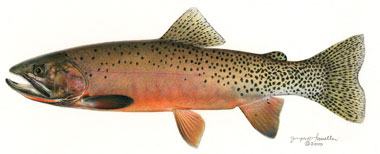
Westslope cutthroat
(Oncorhynchus clarki lewisi)
Common Names
Westslope Cutthroat, Blackspotted Cutthroat, Rocky Mountain Trout
Size Range
Average 8-12 inches. Westslope cutthroat can grow up to 16+ inches in quality populations.
Description
The westslope cutthroat trout is another trout that is a popular game fish and it is one of two subspecies of cutthroat trout that occur in BC. The other is coastal. Westslope cutthroat trout have an olive/bronze colored back and greenish-gold colored sides. Some red coloration can be seen on the gill cover and body. As with all cutthroat trout, they have the distinctive red slash mark on each side of their lower jaw and teeth on the back of their tongue. Westslope spots are primarily above the lateral line and are few there, but quite numerous on the posterior region of the body as well as the on the dorsal, adipose, and caudal fins. The westslope cutthroat trout got its name from being first described west of the Continental Divide. They do however occur both east and west of the Continental Divide.
Distribution
Westslope cutthroat trout can be found in lakes and rivers east of the Cascade mountain range. They prefer pristine headwater streams and alpine lakes. In the river environment, westslope cutthroat trout prefer to occupy deep, slow moving, boulder strewn, glides, along the river bank and the tails of slower moving pools. Those westslope cutthroat trout that inhabit lakes can be found dispersed throughout the lake. However, if other species are present, they will use the nearshore littoral areas.
How to fish for Westslope Cutthroat
Westslope cutthroat trout are aggressive and opportunistic feeders, primarily preying on insects and other invertebrates. This translates into them being a cooperative quarry for anglers. They love natural baits, with the best bait being nightcrawlers or a large garden worm. Small wobbling spoons and spinners are also effective. Fly anglers can be successful using streamers and nymphs as well as dry flies.
In the spring and fall, when the water tends to be cooler, westslope cutthroat will be found near the surface, but they are wary and spook easily. Spin-fishing with a small wet fly or midge and a spinning bubble works best. As summer approaches and the water begins to warm, westslope cutts will seek deeper areas off points and drop-offs. Try trolling with spoons or bait on a leader attached to cowbells or Davis-rigs. During the summer months, shore anglers are successful using worms, cheese, and marshmallows.
Remember, when handling any fish you intend to release, wet your hands first so you don’t take off the fish’s protective slippery coating. Dry hands will remove the protective coating and make the fish vulnerable to bacterial or fungal infections, which can kill them.
Cutthroat Trout Fishing Tips, Tricks and Tactics
Ok, we’re pretty sure you came to this page for our amazing Westslope Cutthroat Trout fishing tips. You can find these tips below. They were put together by our team who researched them and then tested them out in the field. We hope they are as effective for you as they were for us!
- Know the Current – If you understand how a river or stream is shaped by moving water you’ll be able to find trout very easily. Deep pools created by the current can hold a big trout, but smaller trout can also be found in them. The large trout will most likely be in these pools during dawn and dusk.
- Choose Your Lures Wisely – It’s really important to pick the right lures. Using the wrong type could make you miss out on opportunities.
- Power Bait ONLY Works on Stocked Trout – If you’re fishing for trout with powerbait then you better make sure the trout in that body of water were stocked (farm raised) and not native. Native trout will not bite on Powerbait, the only reason stocked trout will is because they are fed pellets in the hatchery and will eat anything that resembles or smells like the pellets.
- The Best Live Bait – Hands down night crawlers are an effective live bait for catching trout, along with minnows and crayfish. A neat trick is to take a look at what lives on the shore of where you’re fishing for trout and see what might be native to their lunch or dinner menu. Mayflies, when native to the area, can be deadly during the fall season.
- The Silver Spoon – Trout, especially lake trout love to bite on a small silver spoon. The best way to use this to your advantage is to buy a lure that mimics a spoon.
Additional Resources for Trout Fishing
Hopefully the information provided on this page will make you more successful at catching trout. However, you may still want to expand your research on trout fishing and look into additional resources. That’s why we’ve provided you with additional places below where you can learn more about trout fishing. If you found our trout fishing tips useful then please share our website with your fellow anglers, friends, family and co-workers.
- Trout Support – The best online training videos available for catching Trout. Learn how to fish like a tournament pro.
- Fishing Records – IGFA – Get real-time information on trout fishing records and records for all other types of game fish.
- Trout Legend – Forum – A great community of fishermen who love to catch trout. This is a great place to meet other fishermen interested in trout and other types of game fish.
- Trout – Wikipedia – Learn more about the different species of trout and get specific information about each species.