.png)
Information & facts
Species Name
Steelhead
(Oncorhynchus mykiss)
 A steelhead also commonly known as a rainbow trout, is a freshwater and saltwater species of fish. They will spend 2 to 3 years out at sea and return to freshwater to spawn. They are native to tributaries of Asia, North America and the Pacific Ocean and have been introduced to over 45 different countries as a game fish. They are on every continent except Antarctica. Steelheads are predators and will feed on virtually any type of fish they can catch. As juveniles they feed on aquatic insects, crayfish, crustaceans, eggs of other fish and small fish that are less than a third of their length. As they become adults they start to consume more fish than any other food source.
 Steelheads are like salmon and are anadromous, meaning they return to the original location where they hatched to spawn. They make several spawning trips per year, transitioning from saltwater to freshwater. Juvenile steelheads will remain in freshwater after they hatch for about a year, and after a year they head out to sea. They return about 2 to 3 years later to spawn and the timing of the spawn is dependent on many different factors. The only difference between a rainbow trout and a steelhead is if a rainbow itself is land locked. Steelheads transition from saltwater to freshwater while rainbow trouts simply stay in fresh water.
How to fish for Steelhead
British Columbia has significant Steelhead populations with some of the best Steelhead fishing located in the rivers around Smithers, BC. These rivers include the Bulkley, Babine, Morice, Sustut and Skeena Rivers.
Steelhead feed on insects, squid, shrimp, and small baitfish. Steelhead can achieve large sizes of over 40 pounds but most angler caught Steelhead are 5 to 12 pounds. Most steelhead are not caught in the open ocean but in the estuaries around spawning rivers and mostly in the spawning rivers themselves. Steelhead are a favorite species of fly fishermen and are known for their ability to fight.
Any time the rivers are in good shape and the thermometer lingers above freezing is a good time to be fishing for winter steelhead. The first few hours following a particularly high tide will mark the arrival of fresh fish from the ocean; rising water will also wake up fish already in the pools.
On southern rivers, frequent downpours will blow out the rivers for weeks on end, but if you can be there when the water recedes, the odds of hooking up on a fresh run are better than average. On northern rivers, mild weather in the mountains can also blow out rivers with runoff; watch for cold nights, which tend to stem the flow.
Flyfishing:
Fly fishing for Steelhead can be done with a 9 to 10 foot 7 or 8 weight fly rod with a matching reel that is preferably a smooth ball bearing disc drag fly reel. Most Steelhead fishermen still use single handed fly rods but spey rods (two handed fly rods) are gaining popularity in Steelhead fishing circles. The fly reel should be spooled with a fly line that matches the weight of the rod and reel and is a WF sinking type 3, 4, or 5.( type 3 has a sink rate of 3 inches per second type 4 is 4 inches a second and so on). Use plenty of backing as Steelhead can make long runs. At the end of your mainline tie on 6 to 10 feet of 12 lb test fluorocarbon leader. A 6 foot leader for faster water and a 10 foot leader for deeper, clear pools. If you are using a tapered tippet use size 0X.
When casting your fly, cast into the middle of pools and let your fly sink and drift into the tailings of the pool (down stream end of pools where water exits the pool) where steelhead are known to hold. Another area to cast is just up from large boulders and let your fly sink and drift around and behind the boulder which can be another Steelhead holding area. As your fly moves downstream follow it with your rod tip.
Fly patterns that are constant producers for steelhead are Babine Special, Freight Train, Showgirl, Skykomish Sunrise, Conehead Muddler Minnows, Conehead Brown Marabou Muddler Minnows, Double Beadhead Golden Biot Stonefly, Beadhead Krystal Bugger Red, Beadhead Mohair Leech Purple, Egg Sucking Leech / Orange Head, Woolhead Sculpin Olive, Flesh Fly, Zonker White, Glo Bug Chartreuse, Glo Bug Pink, and the Glo Bug Pink / Oregon Cheese.
Floatfishing:
Start with a short cast slightly upstream and maintain a straight line between the rod tip and the float without restricting the free float of the rig. Let it drift downstream through the holding water to the end of the pool or until you can no longer control the drift and maintain an effective presentation. Then, pick up and cast a bit farther across and repeat.
Keeping a straight line to the rig requires practice. If the running line is slack, the float tends to drift ahead of the bait, making it impossible to get a good hookset. If the running line is cinched too tight, however, it slows the natural drift of the float, allowing the current to carry the leader and hook up out of the strike zone.
The drift and the action of the float are indicators of what’s going on at the terminal end. Watch closely for any change in the rate of the drift, or for the float to dip into the water, submerge completely or rise unnaturally. Any of these indicators could signal a strike—or a snag. If your running line is straight to the float, it’s simply a matter of raising the rod tip slightly to find out. But if the running line is slack, you’ll miss an awful lot of fish—and that’s definitely not worth freezing for.
That steelhead will move to a lure at all in this numbingly cold water is remarkable, yet move they do, occasionally snatching some morsel from the flow. But they rarely venture far from their lies to do so. As such, the secret is to drift your presentation a hand’s width off the bottom.
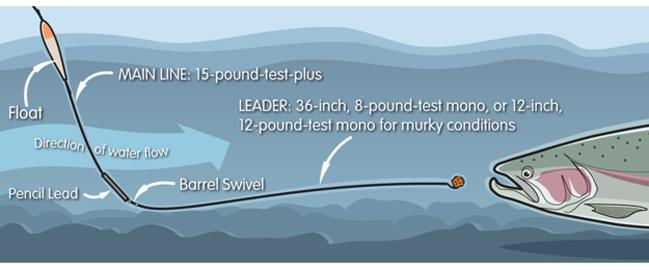
Drifting bait under a float is often the most productive tactic, probably because the offering can be worked through the lies more efficiently than a swung fly. The set-up consists of a float, a piece of pencil lead—heavy enough to submerge all but an inch of the float—and a three-foot, six- to eight-pound-test monofilament leader tied onto a size 4, octopus-style steelhead hook (see diagram below). Use heavier, shorter leaders and larger hooks in low light or coloured water.
For bait, artificial eggs—clusters or singles—work well, as do pink worms, yarn and Spin-N-Glos. Where permitted, cured roe and ghost shrimp often produce better than artificials. As for gear, a 12- or 13-foot rod is typically used, although I’ve also seen 14-footers. And while a free-spooling centre pin reel is best, a level-wind reel can work, too.
 Chris Ciesla
Steelhead Fishing Tips, Tricks and Tactics
- Cover the Entire Area – When you’re casting it’s important to make sure you cover the entire area you’re in before you even think of moving. Start off by casting a short distance and increase that distance by 1 to 3 feet as you go along. Wait until you locate a seam of steelheads that start biting and continue to hit that area while it produces pressure.
- Use a Longer Rod – Using a longer rod such as the Okuma Celilo Graphite Casting Rod will give you a big advantage. By using this rod, more of your line will be above the water so therefore your swing will be slower. This allows you to hook more fish.
- Find Boulders and Rock Gardens – Steelheads are known to lie behind large rocks and in rock gardens. This is a great area to apply pressure to see if you can coax a steelhead to bite.
- Use Several Different Methods – Several different techniques work for catching steelheads. They include: drift fishing, float fishing, fly fishing, spoon fishing and spinner fishing. Do some research on these different methods and see which one(s) might be right for you.
- Artificial Lures Work – There are a variety of different artificial lures that are effective in catching steelhead. It usually comes down to personal preference, but we recommend the Panther Martin Steelhead Spinners.
- Break out the Eggs – Steelhead consider fish egg sacs to be delicacies and during spawning periods they will be honing in on this tasty meal. While this is a basic live bait method it can be very successful in certain locations and at the right time of year. The best part is if you live near an area where they spawn you can get free fish eggs! Just simply harvest, rinse off with water, let them dry for 10 minutes, place in the freezer and only remove them 24 hours before your fishing trip. If you can’t get real eggs then EZ Eggs are your next best option.
Steelhead Facts and Stats
If you need raw facts about steelhead trout then look no further than below. I put together some basic steelhead facts that are useful to all anglers. It’s vital to remember that some of the below data might be an average and not necessarily represent the top 10% of the bell curve for weight, length, size, etc.
- Scientific Name: Oncorhynchus mykiss
- Nickname(s):
- Lifespan: Up to 11 years
- Length: Up to 45″, but on average much smaller
- Weight: Up to 55 pounds, but on average much smaller
- Range: Asia, North America and the Pacific Ocean and has been introduced to over 45 different countries
More Resources on Steelhead Fishing
You’ve now reached the end of your steelhead educational journey. I hope that the information provided on this page is useful to you. You may want to learn more about steelhead trout and trout fishing in general, so that’s why I put together the below list of additional resources. Below you’ll find some 3rd party resources related to steelhead fishing. Hopefully they are useful to you.
- Steelhead University – This is a terrific paperback book that is loaded with knowledge on how to become a better steelhead fisherman. The author Terry West has over 37 years of experience catching salmon and steelhead.
- Trout Legend – Forum – An excellent community of anglers who love to fish for steelhead and all other types of trout. A great place to meet some friends and learn some new tips for trout fishing.