.png)
Pile Perch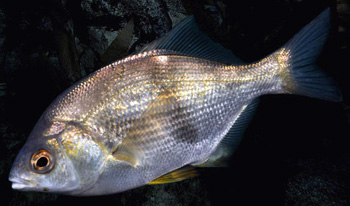
Rhacochilus vacca
Description: The body of the pile perch is a deep oval shape and is compressed from side to side. It is dark gray or brown with a silvery luster that dominates the color on the sides and belly. There are darker blotches on the back and sides. Juveniles have dark vertical bars that diminish with age. This species has 9-11 dorsal spines and 21-25 dorsal soft rays.
Maximum Size: To 44.2 cm (17.4 in) in length and 2 kg (4.4 lbs.) in weight.
Maximum Age: At least 10 years old.
Range/Habitat: Pile perch range from Wrangell, southeastern Alaska to Guadalupe Island, off north-central Baja California, Mexico. Adults are found along rocky shores, often around kelp, pilings and underwater structures, in water depths up to 46 m (150 ft).
How to fish for Pile Perch
Fish for pileperch in rocky areas where mussels abound. They feed at all depths of the water column but mostly on the bottom.
Pileperch love mussels, pile worms (Neanthes succinea), barnacles, sails and small shore crabs. The best baits to use in rocky areas are mussels, pile worms and small shore crabs. These baits are especially effective when they are fished from the rocks over the mussel beds with a bobber or adjacent to the rocks on the bottom. Pileperch have well developed fused pharyngeal tooth plates that enable them to crush hard–shelled invertebrates and feed on whole mussels up to 2.5 cm long. Mussels comprise over 90 percent of the diet of pileperch but they feed aggressively on small shore crabs and pile worms. Collect pile worms and small shore crabs while gathering mussels. Mussels will stay alive in the shell for two days but are cumbersome and messy to haul around. The best way to keep mussels is to shuck and refrigerate them. The mussels will keep up to four days. Fish the mussels, pile worms, and small shore crabs over the rocky beach, from the rocky shore, at the base of rocks jutting from the surf, from jetties, around the pilings and under docks.
When mussels are used as bait it is difficult to keep them on the hook. The problem is resolved by using the following method. Remove the mussels from their shells by using a dull knife, one that is so dull, it will not cut you. Retain the mussel’s beard with the mussel. Hold the mussel by the beard and insert the point of a size number 2 or 4 short shank hook into and through the mussel’s tongue (actually its foot) and into and through the body meat of the mussel. Twist the hook around and push only the point of the hook through the gristle at the base of the mussel’s beard. Trim the beard and the excess body meat from the mussel with a pair of scissors. Mussels hooked in this manner rarely come off of the hook.
Mussel beds are perch magnets attracting perch looking for an easy meal on the incoming tide and shore crabs are at the top of the menu of a pileperch. Bait the shore crab by inserting the hook into the bottom at the rear of the crab pushing the hook up through the back until the point of the hook is clearly exposed. Pop open 3 or 4 large mussels and toss them into the area in front of the mussel bed to attract the pileperch to the bait. It won’t be long before a pileperch takes the crab and bends your rod over.
Fishing on the bottom from the jetties or the rocky shore requires using tackle that is designed to breakaway when it hangs up on the rocks. Each component is tied using monofilament line that is 10 pounds lighter than the strength of the line used on the previous component. Breakaway tackle minimizes the loss of tackle when fishing from the rocky shore or jetties and maximizes the time the bait is in the water. Create a 6 foot long breakaway dropper leader using 30 pound test monofilament line. Tie three dropper loops into the dropper leader evenly spaced apart. Tie one end of the dropper leader to the size 3 barrel swivel on the end of the main line and a size 3 snap swivel to the other end. Tie three 6 inch breakaway hook leaders to three size 4 bait holder hooks using 20 pound test monofilament line. The short 6 inch hook leaders do not hang up in the rocks as often as longer ones. Attach the hook leaders to the 6 foot dropper leader by sliding the loop on the end of hook leader over the dropper leader loop. Slip the 4 bait holder hook through the dropper loop and pull tight. Attaching the hook leader to the dropper loops in this manner facilitates their removal when a hook is lost in the rocks. Tie the appropriate style sinker (round sinkers, teardrop sinkers or slinkys: slinks are preferred) to a short piece of 10 pound test monofilament line and attach the sinker leader to the snap swivel on the end of the 6 foot dropper leader. Bait the hooks with mussels, pile worms or shore crabs.
Vertical fishing with a telescoping fiberglass pole is one of the most productive methods to fish for the perch species common to the rocky structure along BC's jetties and rocky shore or in the kelp forest. Telescoping fiberglass poles extend up to 20 feet. To properly use a telescoping fiberglass pole, fish with a length of 40 pound test monofilament line no longer than the length of the pole. When a fish is hooked use the energy stored in the arching pole to tire and land the fish. Use the energy that is stored in the pole to lift the fish out of the water with one sweeping motion. Some telescoping fiberglass poles are manufactured with a small simple reel attached to the base of the pole. The purpose of the reel if to store the excess fishing line necessary to pull the line free when the baited end hangs up on the rocks. Use a free sliding bobber with an adjustable bobber to fish the bait at the desired depth. Snell a size 4 bait holder to the end of the line and attach a split shot a foot above the hook. Bait up and you are ready to fish. Fishing with a telescoping fiberglass pole is the ideal method to catch the perch and greenling that feed along submerged rocky structure along the jetties, the rocky shore and in the kelp forest.
Fishing utilizing a sliding bobber using a conventional rod and reel rather than fishing with a telescoping pole and bobber is the most common method of using a bobber to fish for perch along the BC Coast. Rig a bobber by setting the bobber stop on the main line at a location that allows the bait to drift at the desired depth usually 8 feet is sufficient. To rig a free sliding bobber, thread a bead and the sliding bobber onto the main line followed by another bead, a lightweight sliding sinker and a bead. Tie a size 3 barrel swivel to the end of the main line. Tie a size 4 bait holder hook baited with mussels, pile worms or shore crabs to one end of a 24 inch 20 to 30 pound test monofilament or fluorocarbon leader and tie other end to the barrel swivel on the end of the main line. Cast the bait and bobber to the desired location. Regardless of the angler’s choice for bait or tackle it is the successful angler that plans ahead by having the bait on hand and the tackle prepared at the time the bait and tackle are needed.