.png)
Eulachon
Latin Name
Thaleichthys pacificus
Group Name
Diadromous
Habitat
A species of smelt native to the northeastern Pacific, eulachon range from the eastern Bering Sea and off the Aleutian Islands to the Californian coast. They are anadromous, which means they travel between freshwater and the marine environment and return to several major rivers and numerous streams in British Columbia, Washington/Oregon and Alaska to spawn. In saltwater, eulachon are typically found at depths of 80 to 200 metres. For reasons still unknown, there was a coast-wide decline in the 1990s, and populations have generally failed to recover. Several explanations have been suggested, including climate-driven changes effecting offshore predator-prey dynamics (i.e. Pacific hake and plankton interactions), spawning river hydrology (earlier, smaller spring freshets) and anthropogenic influences (i.e. dredging, pollution, harvesting and unintentional bycatch in trawls).
Species Description
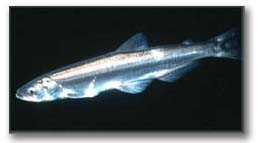
Eulachon are slender, silver fish with a bluish back and a white belly. They have large, canine-like teeth, transparent fins, a forked tail and possess an adipose fin, a small, fleshy fin (without rays) on the median line of the body, near the caudal fin (or tail), characteristic of all smelts and salmonids. At spawning time, eulachon become greyish-brown and are usually toothless, having lost teeth during the latter part of their lives. Spawning males are distinguished from females by tubercles on their heads and near their lateral lines. Eulachon grow to a maximum length of about 25 centimetres.
Source: Fisheries and Oceans Canada