.png)
Information & facts
 The chub mackerel
Scomber japonicus
Also known as the Pacific mackerel or Pacific chub mackerel, is a mackerel which closely resembles the atlantic chub mackerel.
Characteristics
 Most important of the differences, anatomically, is the fact that the chub mackerel has a well-developed swim bladder attached with the esophogas, which the Atlantic mackerels in the Scomber genus lack. But it is not necessary to open the fish to identify it for there is a characteristic color difference between them, the Atlantic being silvery-sided below the mid line, whereas the lower part of the sides of the hardhead (otherwise colored somewhat like the Atlantic) are mottled with small dusky blotches, and the chub has a larger eye than the Atlantic. Less obvious differences are that the dorsol finsare closer together in the chub and that there are only 9 or 10 spines in its first dorsal fin instead of 11 or more, which is the usual count in the Atlantic mackerel. In most species the mackerel is known to travel in large schools. It is a smaller fish than its better known relatives, growing to a length of about 8 to 14 inches.
Chub mackerel school like Atlantic mackerel, and their feeding habits are much the same, eating the same species of palegic crustaceans and sagittea. They follow thrown bait as readily and bite quite as greedily as Atlantic mackerel do. Their breeding habits have not been studied.
Distribution
The chub mackerel is widely distributed, usually found in the northwestern, southeastern, and northeastern pacific. In the eastern pacific it can be found anywhere from central Mexico to Southeastern Alaska. Chub mackerel are generally found within 20 miles off coast in waters between 50 to 72 degrees Fahrenheit. Young mackerels like to live around sandy beaches or kelp beds, while adults are found in deeper waters in shallow banks anywhere up to 1000 feet of depth. Chub mackerel school with other pelagic species as well such as other types of mackerels and sardines. During summer chub mackerels like to travel north and south during winter.
Diet
As larvae, chub mackerel feed mainly on copepods and rotifers and sometimes even smaller larvae of their own kind. Chub mackerel larvae can consume up to 87% of their dry body weight a day. As juviniles, chub mackerel feed mainly of zooplankton. As adults, chub mackerels feed on mysids and euphausiids.
Spawning and maturation
 Spawning between chub mackerel typically occurs at temperatures of 59 to 68°F. This in turn, leads to different mating seasons depending on what part of the hemisphere they are located. Chub mackerel females lay an average of about 100,000 to 400,000 eggs during breeding season. The mackerel is constantly competing with other fish for food, meaning survival rate is not ideal. Although maturation of chub mackerel has never been thoroughly documented, data shows that spawning can happen from March through October, but spawning mostly happens from April through August. Sometimes in females, ripe translucent eggs appear simultaneously with unripe ova in early stages of development; this is also seen with the Atlantic mackerel as well.
Defense mechanisms
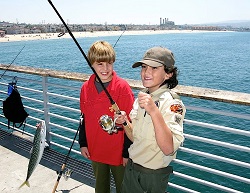 The chub mackerel isn’t a predator, so it relies on camouflaging itself in order to stay hidden from its predators. Although it cannot change colors or spray ink like other marine species, it has a dorsal pattern very similar to the light pattern that the waves and sun work together to emit. When in danger they move close to the surface of the water to merge with the flickering light of the sun. From above it is very difficult to spot the chub mackerel, which helps keep it safe from predatory birds. Camouflage and Evasive Behaviour. This is the technique chub mackerel use to stay hidden from their predators, such as sharks, birds, but mainly tuna.
How to fish for Chub Mackerel
Known to fisherman as the hardhead, the chub mackerel is regularly fished and canned for human consumption, pet food, bait, or served fresh. Chub mackerel are caught all year round, especially between June and November.
Caught on a wide range of baits and artificial lures. A very simple method is also the most common; it is especially useful when fishing from a pier that sits down near the water. Simply attach a size 4-2 hook to the end of the line, put a small split-shot sinker a couple of feet above the hook, and use a small strip of squid, 2-3 inches long, or a bloody strip of mackerel, as the bait. The rigging can be used as is, or used in conjunction with a small float so that the bait stays a few feet under the surface of the water. If available, live anchovies are also excellent bait. When a school of mackerel is in one of their ravenous moods, a Sabiki/Lucky Lura-type bait rig can be deadly and will often produce a fish on every hook (which can lead to tangles and loss of the rig). The most fun can be had with a light outfit and a small artificial lure—a light bonito-type jig or even a cast-a-bubble with a bucktail fly. Generally the bait, whether live bait or cut bait, should be kept moving. A technique that often works is to cast out a high/low leader baited with cut anchovy or piece of mackerel, let it sink toward the bottom, then immediately begin a medium speed retrieve; mackerel will often hit it on the way up, usually just before it gets to the surface. At times, when a school is really hungry, the mackerel will hit on anything and everything (although I think pieces of mackerel are the best bait) and this leads to the common term: “mac attack.” It’s an appropriate title.
As food
According to nutrition specialists, it is said that the chub mackerel is a very healthy meal. It is a fish that is very high in protein and rich in Omega-3 and unsaturated fatty acids which can prevent cardiovascular disease and cancer as well. Due to its high energy and protein intake, and low carbohydrate value, it is recommended in the diets of growing children and pregnant women. In the kitchen and market, the fish is in the best condition if the meat is firm and the eyes are clear with the colors bright. For the most part it is eaten fresh, but can be seen pickled or frozen.