.png)
Information & facts
Species Name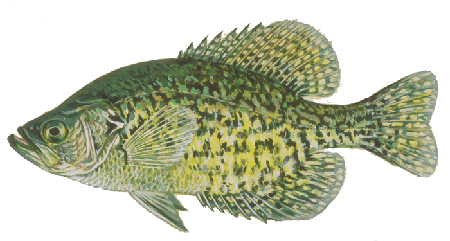
Black crappie
(Pomoxis nigromaculatus)
Common Names
Calico Bass, Papermouth, Strawberry Bass
Size Range
Average 7-9 inches. Crappie can grow to 9-15 inches in quality populations.
Description
Black crappie are one of several "panfish" species in BC and are popular with anglers, because they are relatively easy to catch and are considered excellent eating. Crappie can be identified by their large rounded dorsal and anal fins, and their deep, but narrow bodies, giving a compressed "pancake" appearance. Black crappie are closely related to white crappie and are the more plentiful of the two species in BC.
 They have seven or eight dorsal spines and dark, irregularly-spaced blotches covering their sides. White crappies have five or six dorsal spines, and are usually shaded with dark vertical bars and the base of their dorsal fin is shorter than that of the black crappie. White crappie do not have the number of spots on their sides that black crappie do. Their habitat will usually consist of water that is moderately acidic and highly vegetated. When they are juveniles they feed mostly on prey that is microscopic, such as cyclops, cladocera and daphnia and when mature they will feed on aquatic insects, minnows, and fish fingerlings of other species.
 Crappie are a schooling fish and will also school with other types of pan fish. They prefer underwater structures like fallen trees, weed bends and other structures that might be submerged. Generally during the day crappie tend to stay deep under water and only move to shore when feeding, mostly at dawn or dusk. However, during their spawning period they can be found in shallow water in large concentrations. They do not go into any semi-hibernation during the winter, making them a prime target of anglers that are ice fishing. Crappies, both black and white can have color variance that is affected by their habitat, age and the colors of the local breeding population.
How to fish for Black Crappie
Because of the diverse Black Crappie diet, crappie may be caught in many ways, including casting light jigs, trolling with minnows or artificial lures, using small spinnerbaits, or using bobbers. Crappies are also popular with ice-fishers, as they are active in winter. The black crappie has been widely transplanted and existed in parts of Canada including British Columbia. The black crappie tends to prefer clearer water and can be found in lakes, ponds, streams, sloughs, and creeks. They prefer little current, open areas adjacent to cover, and access to deeper water in winter and summer. The Black Crappie feeds mostly in the early morning and just before dark.
Most Black Crappie are under 2 pounds so ultra light tackle is the gear of choice. A 5 to 6 foot graphite ultra light spinning rod with a matching reel that is spooled with 2 to 4 pound test will provide good action for these fish. Fishing lures that have been productive for Black Crappie are crank baits such as the Norman lures crappie crank in colors blue/chartreuse, bumble bee, silver/blue. These crank baits run to a depth of 6 feet and are 1-1/2 inches long and are 1/8 oz. with #10 hook. Road runner jig heads, Uncle Bucks® Crappie Spinner (fished in short jerks), Marabou Road Runner® Jigs, Bass Pro Shops® Crappie Ringers are all productive lures for Black Crappie. When lures aren't getting bites try bait balls such as Magic Bait Crappie Bites.
Crappie Fishing Tips, Tricks and Tactics
- Artificial Bait That Works– Small jigs work the best, and we find that usually the 1/8 ounce jigs are the most consistently effective. We recommend both this Spinnerbait and this Minnow Bait.
- Use the Right Fishing Knot– If you’re fishing for crappie with a jig you should use a loop knot. This type of fishing knot will allow the jig to move more freely when casted. In addition, it provides crappie with a subtle movement that is very enticing when done vertically to the fish.
- The Best Live Bait Rig– One of the best bait rigs for crappie is to use a #6 hook, a small split shot , a live minnow and a slip bobber. The slip bobber will allow you adjust for any depth while not sacrificing casting ability. Hook the minnow either through both lips or just behind the top dorsal fin.
- Fish the Right Depth– Crappie can usually be found between three and six feet of water. During the peak of summer crappie will move to deeper areas and come out to the surface during dawn and dusk to feed.
- Keep the Line Tight– Crappie are known to have a soft lip. This means that they can tear easily and shake your hook if the line isn’t kept tight enough. Luckily crappie will put up a good fight, so keeping your line tight shouldn’t be a difficult task.
- Don’t be in a Hurry– Crappie will give you more action if you are slow and steady with your jig and/or minnow. Try to avoid retrieving your cast too quickly. If you’re not getting any action and you know crappie are in the area then try slowing down.
- Use a Topographical Map– Since depth is important when trying to fish for crappie you’ll want to make sure you use a topographical map of the body of water you’re fishing. A map will at least contain depths and in some instances sunken structures like fish beds. You don’t need to pay for these, there are tons of free ones available on the internet.
Black Crappie Facts
We’ve put together for you some basic facts and data about Black Crappie. This information is useful to better understand this type of popular game fish and to get an idea of what to expect when fishing for them. The maximum weight and length is from the latest all-time record at the time this information was written. It may have changed slightly, but that is only for the top 0.5% of crappie you’ll find in the wild.
- Scientific Name: Pomoxis nigromaculatus (black)
- Nickname(s): Papermouth, Sac-a-lait, slab, speck and speckled perch
- Average Lifespan: 10 years in the wild and 12 years in captivity
- Length: Up to 19″
- Weight: Up to 5 pounds, average is quarter to half pound
- Range: North America
- Spawning Water Temperature: 58-64 degrees
Additional Resources on Crappie
We hope that our crappie fishing tips are able to improve your success as an angler. However, in case you’d like to continue your research we’ve put together the below resources.
- The Crappie Fishing Handbook – The Crappie Book is a comprehensive guide to crappie fishing with unique insights from an expert. With a logical format and useful and informative tips, this book provides the reader with all the tools for a successful crappie fishing experience.
- Crappie Discussion Forum – An excellent community of fishermen who discuss everything and anything related to crappie fishing.
- IGFA All-Tackle Black Crappie Record – Get real-time data on the current world record for black crappie.