.png)
Information & facts
Latin Name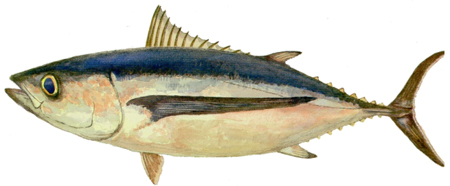
Thunnus alalunga
Taxonomy details
Tuna Species and Science
Group Name
Pelagics
Habitat
Albacore tuna have a wide distribution throughout the oceans of the world, including the Atlantic, Pacific and Indian oceans, as well as the Mediterranean Sea. They prefer warmer waters and are known to migrate great distances. In Canada, they are found primarily on the Pacific coast of British Columbia, and are found at depths of up to 600 metres, though they are generally found at 250 to 350 metres.
Species Description
Albacore tuna are a hefty fish with a fairly short body that becomes quite narrow near their tail, which is quite slender. They have two dorsal fins, the first of which is dark and the second pale yellow. Albacore tuna have dark blue backs and a whitish underside with a faint blue iridescent line running across their flanks. Albacore tuna are distinguished from similar species by their very long pectoral fins. They can grow to well over a metre in length and weigh more than 50 kilograms.
How to fish for Albacore Tuna
There are various factors to consider when choosing the saltwater lures best suited for specific albacore trolling scenarios. Gearing up for the albacore tuna hunt, offshore anglers should anticipate a full-spectrum of potential fishing conditions that may present during their trip, and be prepared to address them with an arsenal of lure choices varying in color, style, and size.
Albacore anglers need to be cognizant of the effects that ocean conditions and trolling speed will have on how a saltwater lure tracks in the water. Crankbait type plugs such as large Rapalas ® and MirrOlures ® are terrific for albacore fishing, as are the traditional cedar plugs. However effective crankbait and cedar plugs are when the seas are smooth, they are extremely difficult to keep in the water during sloppy conditions.
Albacore, at times, may tend to not strike the larger lure sizes. As a rule, utilize the darker color offshore lures when trolling for albacore tuna in the gray of dawn and late evening. As the day brightens, lighter color lures become the better producers. In addition, as the sun continues to grow stronger, keep the lure deeper in the water while trolling. If the wind begins to blow and the ocean starts to get sloppy, your tuna feathers may become ineffective and spend too much time skipping across the surface, this is a good time to consider switching to a Jet Head Lure or some other heavier tuna type jig . Other types of swimbaits can also be very productive for catching albacore tuna, especially when fishing the slide. Many of these lures can be purchased online at Amazon.ca .
When bait fishing for albacore you will most often be using anchovy or sardine for bait. Use a number 2 or 4 hook when using anchovy and a 1/0 to 3/0 hook for sardine. Hook the anchovy either through the nose or the bone behind the gill, for the sardine either the nose or on the bottom of the bait behind the vent, hooking on the bottom tends to make the bait swim deeper. If you're not getting any bites fly lining your bait try a small amount of weight, rubber core sinkers are handy for this because you can add them quickly, remember to change your bait often if the bite is light a natural swimming bait will draw bites that a weak bait won't.
Try getting a bait or jig down about 60'. The bigger fish will be on the bottom of the school and you may wind up with an bigger Albacore tuna taking the bait. The best albacore trolling speeds are within a range of six (6) and eight (8) knots.